
Why Is Palo Cortado So Rare? The Secret of Palo Cortado Casks, Explained with a Sherry Family Tree
2026.10.05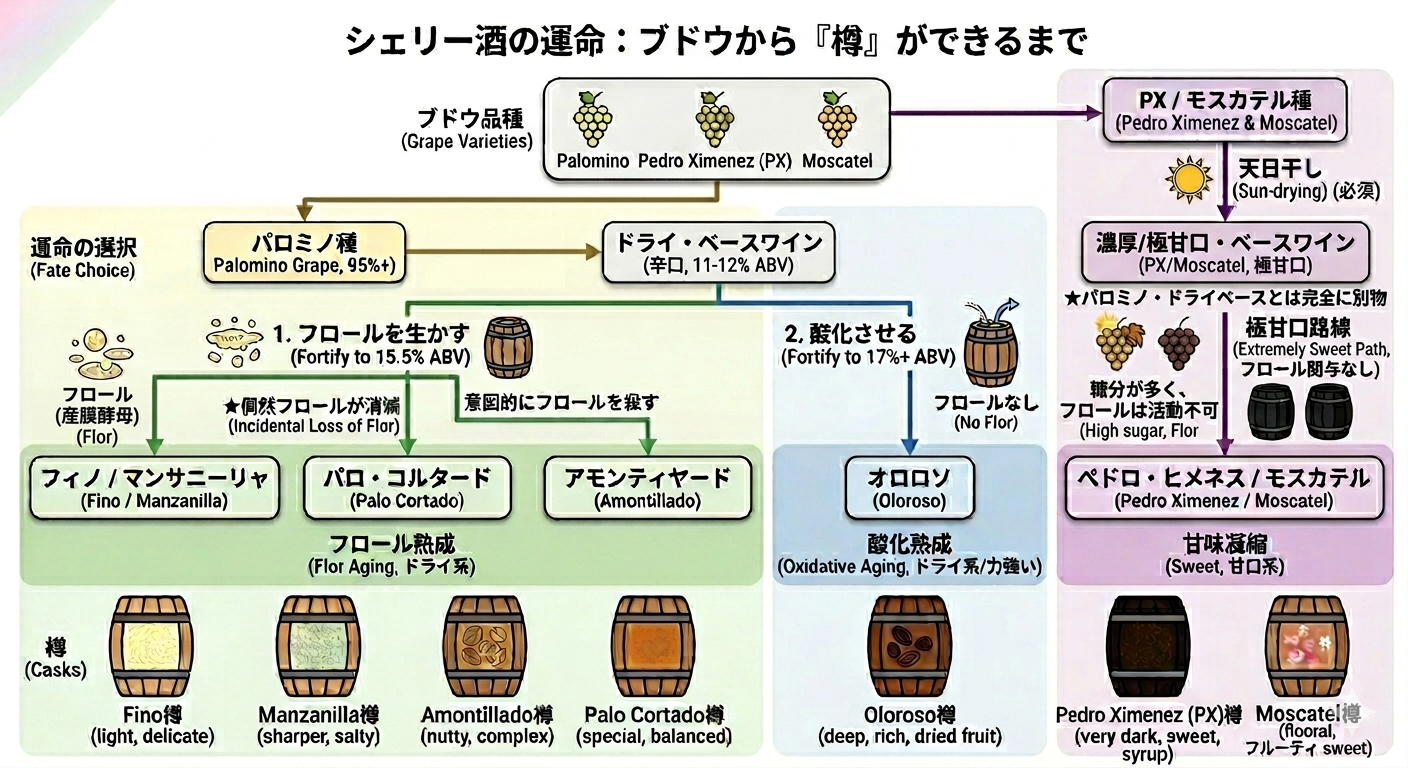
In short: why is Palo Cortado so rare? All sherry starts as an ordinary white wine — mostly Palomino. Fortified to 15.5% it grows flor (fino, manzanilla); to 17%+ it oxidises (oloroso). Amontillado is a fino deliberately turned; Palo Cortado is a fino whose flor vanished by chance — the “cut stick” chalk mark on the cask. Plus a table of sherry cask names seen on whisky labels. By Mika Tanimoto, Bar Little Happiness, Hiroshima.
“Palo Cortado” — a name you see on whisky labels.
What kind of drama does this rare cask, with its complex flavour, go through before it is born?
This is a note for my own reference.
Everything starts as an “ordinary white wine”
Sherry is made from only three white grape varieties — mainly a grape called Palomino.
At first, it is made as a perfectly ordinary dry white wine of around 11–12% ABV.
At this point, it is not yet “sherry.”
The three white grape varieties used for sherry
| Variety | Main role | Character |
| Palomino | Base for dry sherry | The undisputed mainstay, accounting for about 95%+ of sherry production. Its aroma is gentle and not too assertive, so it acts like a “blank canvas” that takes on the changes brought by flor and cask ageing. |
| Pedro Ximénez (PX) | Very sweet sherry | After harvest, the grapes are sun-dried (soleo) into raisins to concentrate their sugar, producing a dense, dark, syrupy sweetness. |
| Moscatel | Sweet sherry | Also sun-dried before use. Lighter than PX, with the bright aroma typical of muscat grapes and fruity sweetness. |
The choice of “fortification” that decides its fate
[Note: what follows is about Palomino (dry), which accounts for 95% of sherry]
By the way, PX (Pedro Ximénez) and Moscatel, used for very sweet sherries, have so much sugar that flor cannot live in them, so they take a completely different path (concentrating sweetness) from this “choice of fate” (flor or oxidation).
This is the biggest fork in the road.
The cellar master tastes the base wine and adjusts the alcohol (fortification) to match its qualities — and that decides which path it will take.
- If they decide “Let the flor live!” → adjusted to 15.5%
- This precise strength is the only environment in which the living film yeast called flor can thrive.
- From here begins the path to “fino” inland, or “manzanilla” in the seaside town.
- If they decide “No flor (go with oxidation!)” → adjusted to 17% or higher
- At that high a strength, flor cannot survive.
- Exposed to air from the start, it takes the path to “oloroso,” drawing out powerful richness.
The drama of “transformation” and “chance”
Sometimes, during maturation, a different drama unfolds from what was originally planned.
- Amontillado
- Matured as a fino, then fortified partway through to kill off (remove) the flor. A hybrid with the delicacy of flor and the nuttiness of later oxidation. Intentional.
- Palo Cortado
- Casks that were meant to become fino, where for some reason the flor disappeared on its own.
- A “product of chance” that cannot be made on purpose — extremely rare, combining the bright aroma of a fino with an oloroso-like powerful body.
The names of “sherry casks” you see on labels
A summary of the main cask types used for maturing whisky.
| Style | Cask name | Character / nuance |
| Dry | Fino | Light, dry, herbal, nutty |
| Manzanilla | Sharper, with a distinctive saltiness | |
| Oloroso | [Classic] Rich, dried fruit, chocolate | |
| Amontillado | Toasty, nutty, complex | |
| Palo Cortado | [Rare] Delicate yet powerful, elegant | |
| Sweet | Pedro Ximenez(PX) | [Popular] Very sweet, raisins, syrup |
| Moscatel | Floral, muscat, fruity |
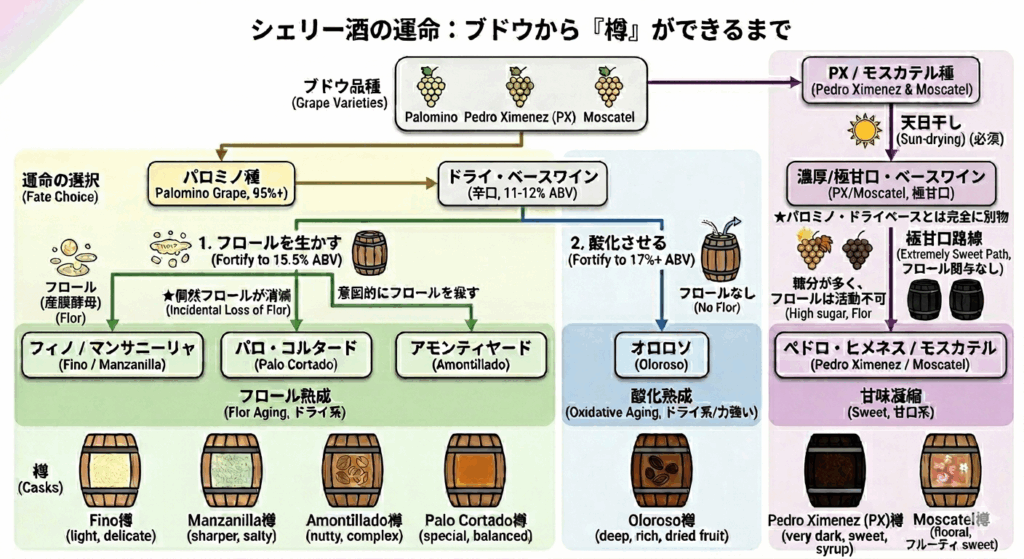
★
“Palo Cortado” means “a cut stick” in Spanish.
It comes from the chalk marks made on the casks.
The mark (|) originally meant for a fino was cut through (/) when the plan changed.
[About the author]
Mika Tanimoto
CEO, Little.m Inc. / Owner-bartender
Since 2006, I have run Bar Little Happiness, a whisky and rum bar in Nagarekawa, Hiroshima. I visit distilleries in Japan and around the world and write about the people who make the spirits. Recipient of the Hiroshima City Excellent Skilled Worker Award.
“Whisky and rum taste even better when you know the hearts of the people who make them.”
[Visit the bar] 📍 Bar Little Happiness
Rolling Nagarekawa 1F, 5-14 Nagarekawa-cho, Naka-ku, Hiroshima
Mon–Sat 7:00 pm – 12:30 am / Sun 7:00 pm – 12:00 am (closed when I travel to visit distilleries)
No cover charge, no reservation needed