
Who Is Ian Chang? What the World-Class Blender Behind Kavalan and Komoro Distillery Told Me
2026.10.05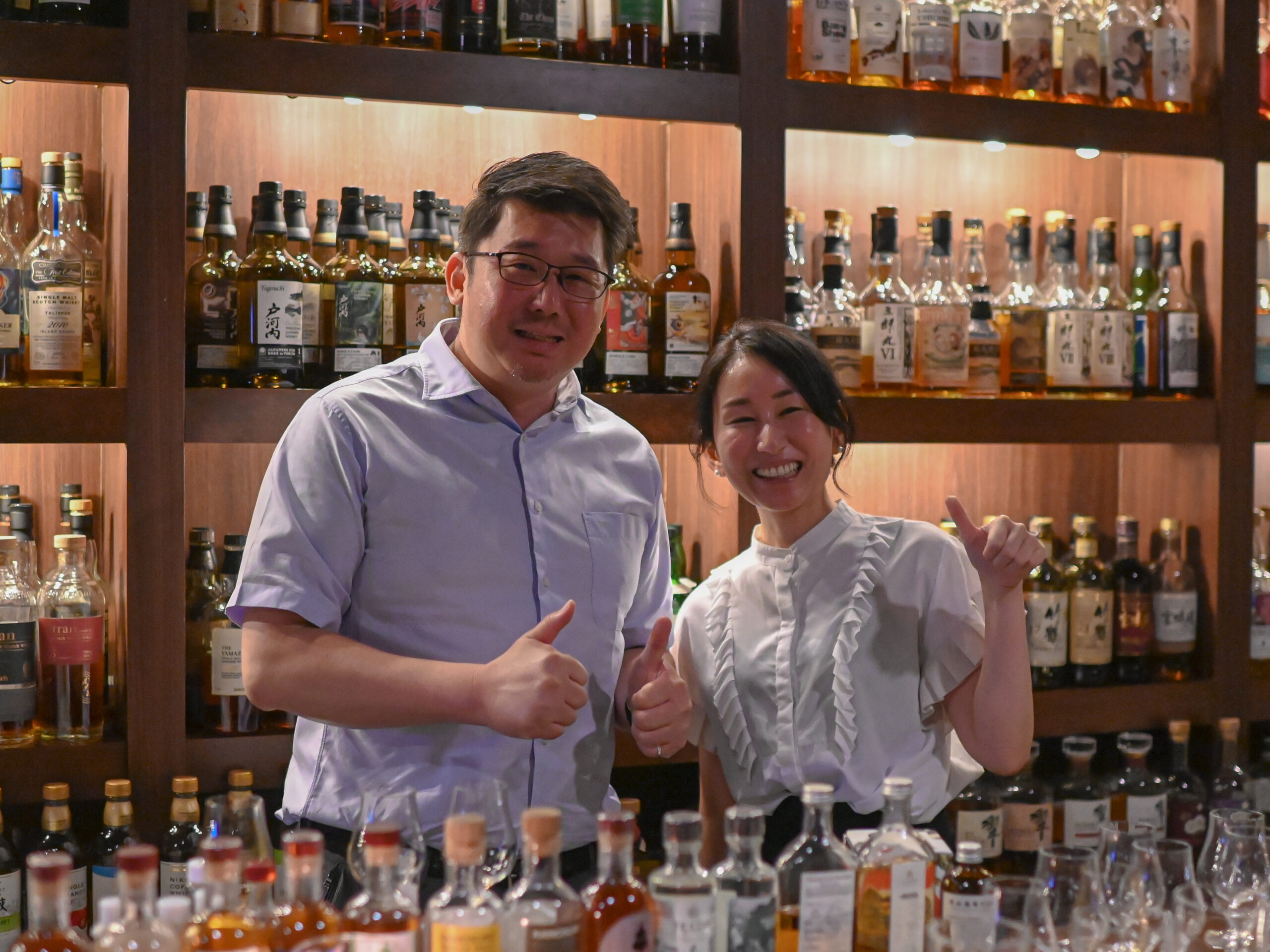
In short: who is Ian Chang? A Taiwanese master blender who joined Kavalan at its founding in 2005 with no experience, studied under Dr. Jim Swan, and won more than 500 gold medals and trophies. In 2020 he came to Japan as master blender and co-founder of Komoro Distillery in Nagano, whose first release goes on sale on 7 November 2026. Based on what he told Mika Tanimoto, owner of Bar Little Happiness in Hiroshima, in person.
About this page: Mika Tanimoto, owner of Bar Little Happiness in Hiroshima, has put this together from what she heard directly from Ian Chang himself.
The Komoro Whisky Festival in March 2026, a lunch together in Hiroshima, and the tasting event held at my bar on 4 July.
I’ve gathered what I heard in person onto a single page.
Who is Ian Chang?
A master blender from Taiwan. As of 2026, he is 52.
In 2005, he joined Taiwan’s Kavalan Distillery at its founding with zero experience in making whisky.
He studied food science and technology at the University of Reading in the UK.
He studied under the late Dr. Jim Swan and later became the first master distiller and master blender in the Chinese-speaking world.
He has personally won more than 500 gold medals and trophies.
In 2020 he left Kavalan, and at 46 he came to Japan. He serves as master blender and co-founder of Komoro Distillery (KOMORO DISTILLERY) in Komoro, Nagano Prefecture.
Komoro Distillery’s first release goes on sale on 7 November 2026.
He joined Kavalan by chance
What led Ian into the world of whisky was illness in his family.
His father, who was working in China, suffered a severe stroke and returned to Taiwan with half his body paralysed.
At the time, Ian was doing military service, and his mother asked him, “Please come home and look after the family.”
So he looked for work near home.
Kavalan was 20 minutes from his house by car.
That, he says, was the only reason he applied.
The selection was a series of nosing (sense of smell) tests.
There must have been many others applying for the same job.
When I asked, “Why you?”, Ian prefaced it with “I may be wrong, but…” and answered:
“I spent nine years as a student in the UK and needed to deal with people from Scotland and Britain, so maybe that was seen as an advantage.”
When he joined, Kavalan was still under construction.
Starting from building the distillery. From nothing, from zero.
This experience of “starting from zero” would connect to Komoro 20 years later.
For the first year, he did nothing but read whisky books, he says.
What is Kavalan Distillery?
Founded in 2005 in Yilan County, Taiwan, it is Taiwan’s first full-scale whisky distillery.
It is run by King Car Group, a major Taiwanese food and beverage group.
The company behind Mr. Brown, Taiwan’s iconic national canned coffee.
Its first new make spirit was produced in March 2006.
Kavalan is the distillery that overturned the world’s common belief that “you can’t make whisky in the subtropics.”
When it was founded, founder Lee Tien-tsai was told by experts all over the world that it was “impossible.”
Yilan has a subtropical climate, with average summer temperatures over 30°C and humidity reaching 100%.
An environment considered harsh for making whisky.
Kavalan devised its own way to use this not as a weakness, but as a weapon.
Maturation proceeds at tremendous speed — and at the same time, the contents of the cask are lost at tremendous speed.
Kavalan’s rich, mellow flavour is born on that knife-edge balance.
Major awards
- 2012 | Solist Fino Sherry Cask named “New World Whisky of the Year” in Jim Murray’s Whisky Bible
- 2015 | Solist Vinho Barrique named “World’s Best Single Malt Whisky” at the World Whiskies Awards
- 2016 | “Worldwide Whiskey Producer of the Year” at the International Wine & Spirit Competition (IWSC)
- 2026 | “Distiller of the Year” at the World Whiskies Awards
- More than 950 gold medals in total since its founding
India’s Amrut, Australia’s Starward, Taiwan’s Kavalan. Distilleries in warm climates are putting their terroir to the world not as a handicap, but as individuality.
I believe Kavalan is one of the key players that made the term “New World Whisky” commonplace in the industry.
What he received from his mentor, Dr. Jim Swan
The turning point was meeting Dr. Jim Swan in 2006.
He was called “the Einstein of the whisky industry” (he passed away in 2017).
Ian himself looks back on it as “where my formal learning began,” and the doctor drilled everything about whisky-making into him.
The first thing the doctor taught Ian, he says, were these words:
“Whisky is a living thing. It’s different from a beverage. With Coca-Cola, if you have the recipe, you can make the same thing anywhere. But whisky is different. You have to change the way you make it to suit the climate, the conditions and the water of the place.”
You can’t bring Scotland’s way straight into Taiwan.
Because the temperature and humidity are completely different. This teaching became the foundation of the challenge of making whisky in the subtropics.
What Ian had studied was food science and technology, and he says his lectures barely touched organic chemistry, the core of whisky.
Dr. Jim Swan was exactly the person from that field.
It took about ten years for his own style to settle.
Those years overlap exactly with the years he kept learning under the doctor.
And one more thing. Even after Ian and his colleagues left Kavalan, Kavalan has kept winning awards.
When I mentioned this, Ian said, quite matter-of-factly:
“It’s stable because they’re all good people. I learned not only with Dr. Jim Swan, but together with my colleagues at Kavalan.”
I think Ian left something at Kavalan that would carry on even without him.
Why did he leave Taiwan?
In 2020, Ian left Kavalan.
A place he had supported at the technical front line for 15 years.
I asked how he felt.
“When I left Kavalan, I was really sad. Kavalan was like a baby I raised from zero — from age 0 to 16. My wife, my mother, even my daughters — the whole family was very sad.”
A child raised from zero to 16. That metaphor carries all the weight of the years he poured in.
After leaving Kavalan, what Ian was thinking about was not settling at one particular company, but becoming a consultant.
That way, he could work with all kinds of makers and share his experience with many distilleries.
In fact, several offers came in, he says.
A large company invited him to build a distillery for its brand.
But that plan was very cautious, and even now, years later, it still hasn’t got moving, he says.
Another deal had gone almost as far as a contract — and just then, the pandemic began.
“If I had taken that deal, my life might have been different. I might not be here.”
Ian was also truly tired at that time.
He spent more than 200 days a year giving talks and had been away from home for ten years straight, so he says he couldn’t even watch his daughters grow up.
Right in the middle of that searching, he met Komoro Distillery.
Why Komoro?
“It was an almost perfect connection. For me, it was a destined encounter.”
Takashi Shimaoka, founder of Karuizawa Distillers Inc. (KDI), which runs Komoro Distillery, originally came from the world of finance.
A former Citibank trader, he had a rich network and the ability to attract investment.
After hearing Mr. Shimaoka’s vision in an online meeting through a screen, Ian’s answer was: “I’m in!”
At first, Ian intended to be involved with Komoro as a consultant, too.
But Mr. Shimaoka didn’t want Ian working with other companies.
“Why don’t you join us? I’ll make you a co-founder.”
This invitation matched exactly what Ian truly felt deep in his heart.
“In my heart, I also wanted to start a new project from zero again. So this was a perfect opportunity.”
About their roles, he says:
“The president’s strength is his large network. That’s why investment gathers and he can receive it. My role is to make whisky and to raise the next generation. Personally, I think it’s a very good combination.”
One who handles the business, one who handles the making.
When I said, “Like Shinjiro Torii and Masataka Taketsuru,” Ian laughed: “I like that.”
And one more thing that moved Ian’s heart was the land of Komoro itself.
When he heard “Nagano,” the first thing that came to mind, he says, was that it’s the place in Japan where people live the longest.
Komoro Distillery, and water that takes 50 years to spring
Komoro Distillery stands at 910 metres on the slopes of Mt. Asama, an active volcano (about 2,500 metres high).
It began distilling in 2023.
Here, the story of the water is essential.
It takes about 50 years for spring water from the summit of Mt. Asama to come down to this land.
Filtered naturally through the earth for 50 years, it becomes hard water full of minerals.
Why hard water? Ian says he is often asked that.
His answer is clear: for fermentation.
The rich minerals in hard water work very well to activate yeast.
Not only for yeast, but for the other microorganisms involved in fermentation, they are nutrition — like vitamins for humans.
So hard water is needed to raise the level of fermentation.
There’s a part of this water story I love most.
Ian came to Japan and joined Komoro in 2020, at 46. And now he is 52.
“Water that takes 50 years to come out means I’m now using water from almost the time I was born.” “Maybe I was born to come to Japan.”
He said it with a playful laugh.
That water, then, had been waiting here for Ian all along.
Whisky-making at Komoro Distillery
Malt and fermentation
They choose their malt after comparing several.
The deciding factor was a higher starch content. Starch turns into sugar and then alcohol — the foundation of the spirit.
Fermentation takes 72 hours.
Of that, roughly the last 10 to 15 hours are given to lactic fermentation.
Special yeast and patient, long fermentation. These two paint that fruity new make.
The taste of the new make
The non-peated new make is reduced to 46% and has almost no alcohol burn.
Generally, many new makes have a sharp, pungent smell, but Komoro’s is surprisingly gentle.
Ian describes it as “like ripe fruit.”
Peach takes the lead. Then strawberry. The freshness of green apple, and a citrus touch like kiwi.
Hold the glass a little further away and sniff, and lychee hides in the back.
On the palate, a toasty, biscuit-like malt. The finish is sweet.
Maturation — “Summer is sandpaper, winter is oxygen”
Ian says Japan’s climate is “right between Taiwan and Scotland.”
Hot summers like Taiwan, cold winters like Scotland. Having both is the key to maturation, he says.
Hot summers act like sandpaper polishing rough edges. Cold winters send oxygen into the casks and nurture more refined aromas.
They use STR casks (shaving, toasting, recharring) inherited from Dr. Jim Swan.
A technique that adds complex flavours, unlike major producers, in a short time.
The warehouse is called “Jim Swan House,” named after his mentor.
Designed as if to seal in the forest environment, it takes nature’s blessings into its architecture while keeping its environmental impact low.
A gentle peat burned at Christmas
Komoro Distillery makes peated spirit only once a year: about two months, from 1 December to the end of January.
Why that time?
Because Dr. Jim Swan’s birthday was 25 December, Christmas.
The doctor loved lightly peated whisky.
So at Komoro, they burn a gentle peat in that season. What came of it is the “Christmas Newborn.”
The peat level is about 25 ppm at the malt stage.
From December to January, the whole distillery is wrapped in an aroma like smoky bacon, I was told.
“It smells so good that I’m always hungry.”
Why a deliberately light peat?
Because if it’s peated too heavily, that fruitiness — and the distillery’s own character — gets buried under smoke.
What Ian aims for is fruitiness and smokiness together.
When Suntory’s master blender, Mr. Fukuyo, tried this Christmas Newborn, he was surprised: “How many years has this been matured?”
The answer was 13 to 15 months.
The philosophy of whisky-making — “harmony” and “art and science”
The keywords Komoro Distillery holds dear are harmony and balance.
Once, when Ian asked Mr. Fukuyo, “What is Japanese whisky?”, the answer was, “It’s harmony, and balance.”
When asked in interviews “What is your benchmark in Japan?”, Ian always answers Suntory.
He truly respects their blending skill, he says.
Ian believes whisky-making is “a combination of art and science,” in equal halves.
It’s his belief that a great blender needs not only scientific knowledge to secure the quality of new make, but “imagination” — to picture the taste when different spirits come together.
Comparing the blender to a chef, he creates the final glass as a work of “art” by combining new makes of many colours and characters, called a “raw spectrum.”
What he is trying to express through Komoro’s whisky is an “Artistic Conception”: a deeply emotional experience that evokes “the feeling of being surrounded by forest” and “the changing seasons.”
How he raises people — “You don’t need experience”
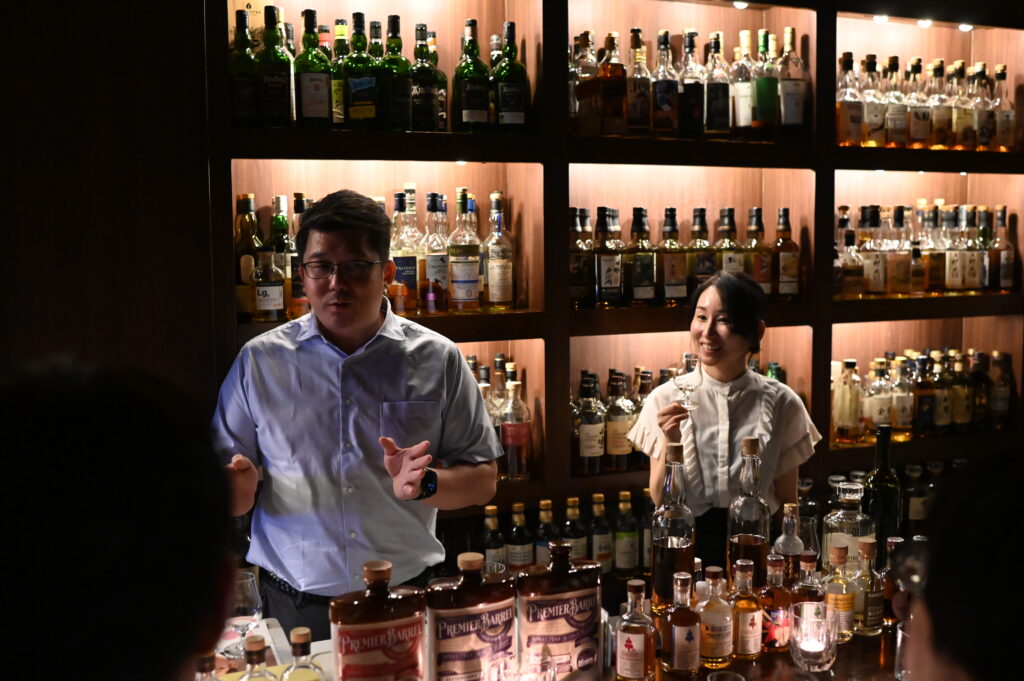
On 4 July, Ian came all the way to Hiroshima with two young blenders.
What surprised me was that neither had been poached from another distillery — both were new graduates.
Ian doesn’t poach staff from other makers.
He raises new graduates who start from zero with his own hands.
Ian himself learned under Dr. Jim Swan with no experience and pushed Kavalan to the top of the world.
“You don’t need experience. The most important thing is passion.”
Winter in Komoro drops to minus 10 degrees.
In that cold, you get up at 4 a.m. and head to the distillery.
You can do that because you have passion, he says.
So how does he see that passion in an interview?
Ian’s answer was simple.
“It’s the sixth sense.”
Talk with someone, and intuition tells you what kind of person they are. And so far, that intuition has never been wrong, he says.
One of them is Shibuya-san.
Originally a PhD in fish immunology, from a world that had nothing to do with whisky.
Through the screen of an online interview, Ian had a gut feeling: “This person can become a very good next generation.”
And after coming to Japan, Shibuya-san was given exactly the same nosing test as at Kavalan — and passed.
Succession — “planting a tree”
Running through all of Ian’s stories was always one line: “receiving from someone, and passing on to someone.”
“Whisky is the same as growing a tree. You decide to grow a tree for the next generation. When the tree grows big, people can enjoy its shade. What we are doing now is for future generations to enjoy.”
There was an event that backs this up. When he visited Glenfarclas with Mr. Shimaoka, the blender let them taste a 70-year-old whisky.
“I won’t be able to see Komoro’s 70-year-old. No matter how much medicine advances, it’s impossible. So it’s for future generations to enjoy.”
Seventy years ago, someone filled casks for a next generation they would never meet, and now, in this age, we get to taste it. We are sitting in the shade of a tree planted 70 years ago.
Komoro Distillery plans to build up 3, 5, 8 and 10 years, and to start stating ages from 12 years.
What it has in sight beyond that is 30 years.
Distillation began in 2023, so by the time a 30-year-old is ready, Ian will be 78.
At Kavalan, maturation averaged about 3 to 8 years, he says.
That’s exactly why, at Komoro, they are settling in to take on long maturation.
“Komoro is our Top Gun school.”
Here they train operators and blenders, who will eventually become the ones teaching at new distilleries.
When Ian met Mr. Shimaoka, he told him:
“We should pass Dr. Jim Swan’s know-how on to the whisky makers of the future.”
Succession means passing on knowledge, and at the same time, finding someone you can pass it on to. That’s what I learned.
Komoro Distillery today, and what comes next
The first release goes on sale on 7 November 2026.
The non-peated newborn I tasted at the event was under two years old, yet already a solid amber.
Ian calls it the “Spring Newborn.”
A name celebrating this year’s spring in the Karuizawa and Komoro area.
“In Japan, too, you can make whisky from zero that holds its own against Scotch.”
KDI’s vision doesn’t stop at Komoro.
- Furano project | In Furano, Hokkaido, a second distillery, “Furaliss,” developed jointly with the Seibu Group, is getting under way. Eight pot stills. The plan is to produce three different styles from one distillery, with nearly four times Komoro’s output, I was told
- Third distillery | being planned in the south
- To No. 3 in Japan | once these are running, KDI plans to leap to become Japan’s third-largest producer
- The world market | including plans for a logistics base in Singapore, a system aimed at the global market from the start is in place
- Tourism | 60 minutes from Tokyo by shinkansen
Founder Takashi Shimaoka has publicly stated that he will make KDI “a powerhouse of Japanese whisky.”
Ian himself said:
“We are making Japanese single malt. As part of this industry, I want to make friends.”
Precisely because he came from Taiwan, he places great value on becoming part of Japan’s whisky industry.
He wants to deepen ties with other distilleries, talk with them, inspire each other, and contribute to this industry, he says.
The Ian Chang I met
I first met Ian at the Komoro Whisky Festival in March 2026.
His seminar was sold out, and the seat I could get was in the very back row of the “three-distillery cross talk.”
I was just one member of the audience.
The ruby port cask spirit from Komoro served there shocked me.
Even reduced with water, it had none of the rough new-make edge.
Even though it hadn’t been three years since distillation began. I thought this person was a genius.
And there was one more thing I felt strongly.
Despite being so famous worldwide, he never lost his respect for the distillers beside him, or for the people listening.
“I have to trace his roots,” I thought, and immediately booked a ticket to Taiwan — to see Kavalan Distillery with my own eyes.
While those preparations were quietly going ahead, an email arrived. From Ian’s side: “Would you let us hold a tasting event at Little Happiness?”
My first thought was, “Is this a prank?”
Why me, just one person in the audience?
It was apparently because of a blog post I had written.
Much of the “beginnings” story on this page I heard over lunch together in Hiroshima, before the tasting event.
It was supposed to be a meeting about arrangements, but before I knew it, I was asking Ian about his whole life.
Almost none of these stories appear in Japanese interviews.
And on 4 July 2026, a tasting event limited to 11 seats came true. I wrote about that night in four parts.
I felt Ian is a person deeply congruent with himself.
What he wants to do and what he does. The values he believes in and his daily life.
His aspirations and his work. Nowhere is there any gap, pretence or strain.
Because he carries no contradictions, there is no forcing.
A maker’s way of being is always reflected straight into the whisky.
Komoro Distillery’s whisky will be harmonious and beautiful. I’m sure of it.
Read more — related articles
Tasting event series (4 parts)
- Part 1: Whisky was the language that connected people
- Part 2: Komoro Distillery’s new make, and water that takes 50 years to spring
- Part 3: A gentle peat burned at Christmas, and a philosophy of maturation
- Part 4: From Kavalan to Japan — Ian Chang’s passion and legacy
Articles that dig deeper into Ian Chang and Komoro Distillery
- Ian Chang’s “beginnings” and a story of legacy
- The “harmony” I witnessed at Komoro Distillery
- What is Kavalan? Taiwan’s world-class whisky and the story of Ian Chang
What you can drink at Little Happiness
For Kavalan, we stock mainly the Solist series.
Each cask gives a completely different direction of flavour. Please compare them at the counter.
We plan to serve Komoro Distillery’s whisky after its first release on 7 November 2026.
Arrivals will be announced on our official LINE.
“Whisky and rum taste even better when you touch the hearts of the people who make them.”
Every encounter is meant to be. Welcome to the world of Rum&Whisky.
[About the author]
Mika Tanimoto
CEO, Little.m Inc. / Owner-bartender
Since 2006, I have run Bar Little Happiness, a whisky and rum bar in Nagarekawa, Hiroshima. I visit distilleries in Japan and around the world and write about the people who make the spirits. Recipient of the Hiroshima City Excellent Skilled Worker Award.
“Whisky and rum taste even better when you know the hearts of the people who make them.”
[Visit the bar] 📍 Bar Little Happiness
Rolling Nagarekawa 1F, 5-14 Nagarekawa-cho, Naka-ku, Hiroshima
Mon–Sat 7:00 pm – 12:30 am / Sun 7:00 pm – 12:00 am (closed when I travel to visit distilleries)
No cover charge, no reservation needed