
Turning Passion into Work: What Immersive Fort Tokyo and a Robot Café Taught Me as a Small Bar Owner
2026.10.05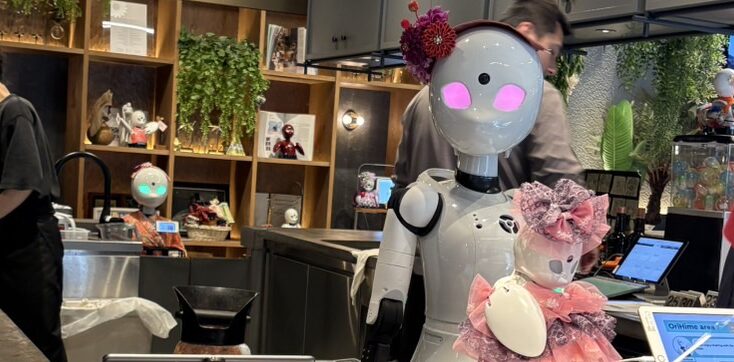
In short: not a drinks article, but a reflection on running a business. After experiencing Immersive Fort Tokyo (immersive theatre in Odaiba) and an avatar robot café in Nihonbashi staffed remotely by people with physical limitations or who were once socially withdrawn, Mika Tanimoto, owner of Bar Little Happiness in Hiroshima, thinks about how passion becomes “experience value” — and a sustainable business.
— Thoughts after experiencing Immersive Fort Tokyo and a robot café —
Lately, as I have been rethinking how I run my business, I wanted to write down what I felt — partly as a note to myself.
This article is not about drinks.
But if you are someone who thinks about creating spaces or about how we connect with people, I would be happy if it offers even a little empathy or a hint.
■ The experience of Immersive Fort Tokyo
Immersive Fort Tokyo in Odaiba, Tokyo, is a theme park of immersive theatre, where you go beyond “watching” and are drawn right into the story.
The performers’ acting felt as real as watching a dubbed film come to life in front of you. Their intonation, movement, pauses, the direction of their gaze — all of it made them exist not as “people playing a role” but as “people living there.”
In Japan, the culture of “paying for acting” is still limited, and making it work as a profession is not easy.
Even so, this space combined script, space, staging and IT to create something designed to make you think, “I want to go there and experience it.”
Visiting it, I felt that the things AI and systems cannot create — the “power to read the air of the moment” and the “live nuance that acts on the person right in front of you” — were truly being put to use.
I think Immersive Fort was also a place where this kind of “expression only humans can do” was properly supported by a system, and made to work.
▲ The Sherlock Holmes
▲ The Midnight Banquet
■ What a robot café asks about the meaning of “work”
Another place that made a deep impression on me was a robot café in Nihonbashi (DAWN ver.β). Here, people with physical limitations, and people who were once hikikomori (socially withdrawn), serve customers remotely through avatar robots.
The person who served me had also once been withdrawn from society. Finding it hard to go out and work, they learned about this café, thought, “Maybe I can do this too,” and started working there.
They told me, in a calm voice, that being with people used to frighten them, and they did not even know how to behave in society — but the customers here were very kind, and for the first time they felt they had a “point of contact with society,” which made them happy. That stayed with me.
Hearing that, I realised for the first time that this is not simply a place for “people who cannot go out physically.”
It is also a place where people carrying invisible anxieties or a sense that life is hard can find their own way of working, their own role and their own value. It was a space that gently asks what “working” really means.
I also felt it was deeply meaningful that this system is not held up by goodwill alone: the work is treated as “a real role,” and people are properly paid for it.
The robot café (DAWN ver.β)
■ The management skill that turns passion into “experience value”
What Immersive Fort and the robot café had in common was that both turned “passion” into “experience value” and made it work as a business.
It was not just idealism. They turned it into a real design, using space, people and technology to carefully deliver “what they want to convey.”
Behind it was the power of management: taking in each person’s will — “I want to work,” “I want to deliver this” — and supporting, as a “system,” the parts that will alone cannot sustain.
I think it was business design that raised activities that “at first glance are hard to get paid for,” such as acting or remote customer service, to a level “worth delivering as an experience.”
■ What I thought as the owner of a small bar
Today I run a small bar on my own in Hiroshima.
The scale and the structure are completely different, but there is a lot I can learn from examples like these. In particular, their attitude of turning “passion and commitment” into an “experience,” and making that work as a “business,” holds many hints for me.
Each took a completely different form,
but in both Immersive Fort and the robot café
I saw real ingenuity and reality: “someone’s passion” properly turned into a system and delivered.
And I feel that this truly overlaps, even if the form is different,
with the work of this bar that I keep running today.
[About the author]
Mika Tanimoto
CEO, Little.m Inc. / Owner-bartender
Since 2006, I have run Bar Little Happiness, a whisky and rum bar in Nagarekawa, Hiroshima. I visit distilleries in Japan and around the world and write about the people who make the spirits. Recipient of the Hiroshima City Excellent Skilled Worker Award.
“Whisky and rum taste even better when you know the hearts of the people who make them.”
[Visit the bar] 📍 Bar Little Happiness
Rolling Nagarekawa 1F, 5-14 Nagarekawa-cho, Naka-ku, Hiroshima
Mon–Sat 7:00 pm – 12:30 am / Sun 7:00 pm – 12:00 am (closed when I travel to visit distilleries)
No cover charge, no reservation needed