
From Tennessee Bourbon to Sugarcane in Asakura, Fukuoka: How President Tanaka Came to Make RURU RUM
2026.11.21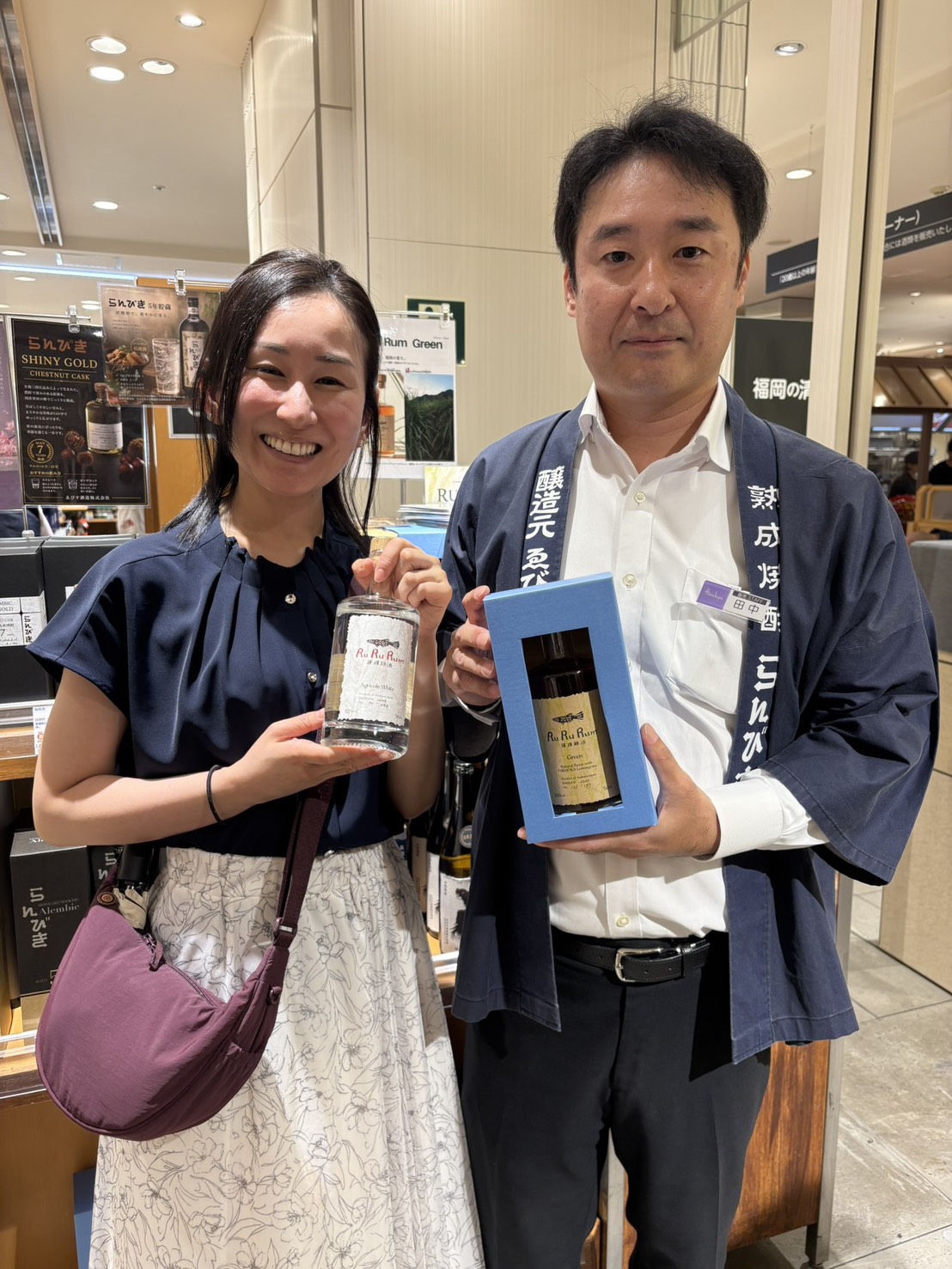
RURU RUM is a Japanese rum made by Ebisu Shuzo, a shochu distillery in Asakura, Fukuoka Prefecture.
They grow their own sugarcane and make rum from its fresh-pressed juice.
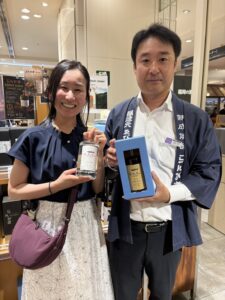
This time, President Tanaka shared many stories with me: from the year he spent in Tennessee, USA, to growing sugarcane in Asakura, researching yeast, and his thoughts on making rum.
In This Article|RURU RUM Interview
RURU RUM is a Japanese agricole rum made by Ebisu Shuzo, a shochu distillery in Asakura, Fukuoka, from the juice of sugarcane they grow themselves.
- An unexpected reunion at Hakata Hankyu
- President Tanaka’s roots: a year in Tennessee
- Why a shochu distillery started making rum
- Growing sugarcane in Asakura
- Agricole rum, sugarcane varieties and harvest timing
- Yeast research in search of the ideal aroma
- Making rum with a shochu still
- The medaka and deer on the label
- Aiming for a rum loved by local people
- Official tasting notes
An Unexpected Reunion
September 2026. The day I was heading home to Hiroshima after touring distilleries in Kagoshima.
An earthquake had stopped the shinkansen, so my travel options were a little limited this time.
There were other distilleries I wanted to visit, but they are far apart from each other.
Since I was going to meet the makers, I wanted to avoid being rushed for time.
With that in mind, I had kept my schedule from getting too packed.
While waiting for my flight home, I decided to call RURU RUM in Asakura, Fukuoka, which I had been curious about for a while.
I asked whether someone involved in making the rum might have time to talk with me directly.
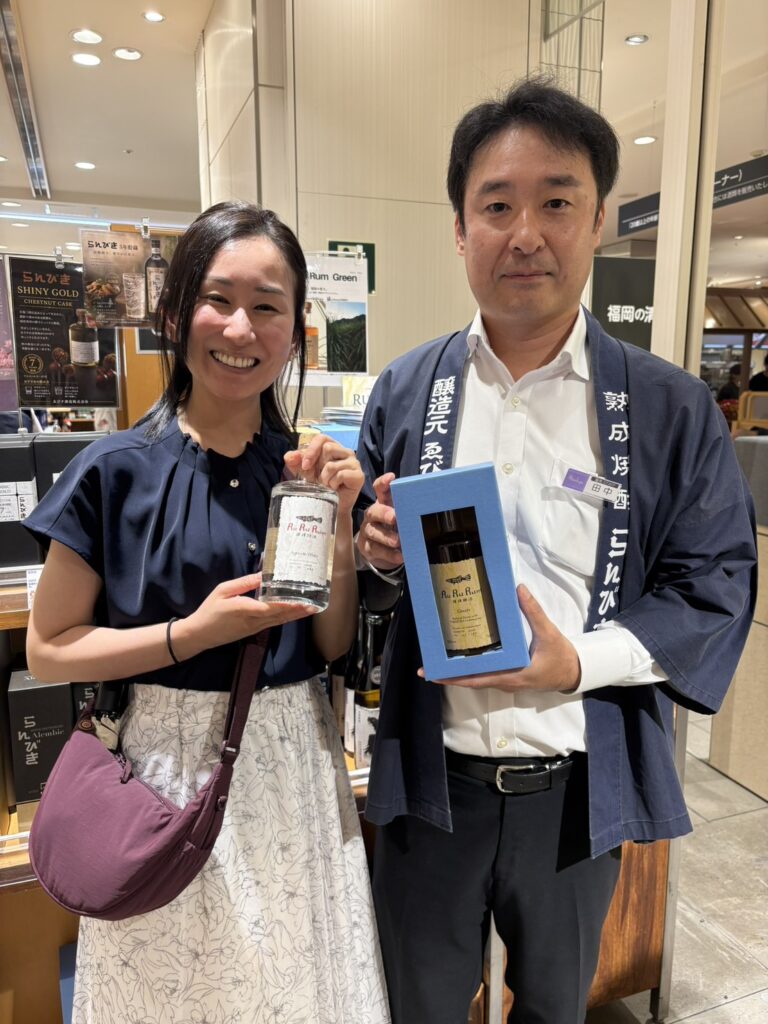
It turned out that President Tanaka was at a special sales event at Hakata Hankyu department store that very day.
What timing!
Since I was flying from Kagoshima to Hakata, the department store was much easier to stop by than the distillery in Asakura.
I had planned to go back to Hiroshima and open the bar that day, but as soon as I arrived in Hakata, I headed straight for Hankyu.
And there, I learned something unexpected.
“I visited your bar a few years ago.”
President Tanaka had once come to my Bar Little Happiness together with someone from a shochu distillery in Kagoshima.
On the way out, we had even talked a little about rum.
But I didn’t remember it at all.
Looking back, a few years ago was a time when I was trying to change the shape of my bar completely.
From running a bar with staff to running it on my own.
It was a time when I was trying to sort out everything I had built up until then.
It was terribly rude of me, yet he just smiled and said, “Don’t worry about it!”… Thank you so much!!
Longing for Bourbon and the Blues: A Year in Tennessee
As I listened to President Tanaka, the conversation unexpectedly came alive when we talked about his time in America.
The first drink he fell in love with as a university student was bourbon.
Early Times and Jim Beam.
Drinking the bourbons he could afford at the time, he was drawn to the culture of the American South: blues, country music and westerns.
President Tanaka was born the eldest son of a shochu distillery that has been passed down for generations.
His father never strongly told him to take over, but it was simply taken for granted around him that he would one day inherit the family business.
He himself had decided he would return to the distillery someday.
But before that, he really wanted to go to America.
His destination was Tennessee.
“Please let me go for just one year, on the condition that I come back to the family business.”
With that kind of bargain, he went to America to attend a language school.
Nashville, where he stayed, is a city of music.
There are many studios and live music venues, and even places where you can listen to music for free.
Music lovers gather there, and if you bring a blues harp, you can join a jam session.
Living like that, he drove around Tennessee and Kentucky.
“There was alcohol in everything, and it was fun.”
Those words left a strong impression on me.
He loved music and he loved bourbon, and he jumped into a place where he could enjoy both.
Listening to him, I found myself wanting to visit the Nashville of those days, too.
After returning to Japan, he worked for a food wholesaler, trained for about three months at the National Research Institute of Brewing, and joined the family business at 26.
Later, as his father’s health declined, he took charge of production while learning from a long-serving master brewer (toji), and became president before turning 40.
“I also love things that are old and have lasted a long time.”
President Tanaka carries on a long-established shochu distillery while taking on new challenges.
I thought it was wonderful that at the root of it all is a year in America when he was absorbed in bourbon and music.
Why Would a Shochu Distillery Make Rum?
I asked President Tanaka why he decided to make rum in the first place.
What surprised me was that he hadn’t originally drunk much rum.
However, he had long been using old rum casks to age his shochu.
Casks that were first used for bourbon, then used to age rum in Central and South America.
Those casks turned out to be very good.
President Tanaka, a lover of bourbon, became interested in rum by way of bourbon casks.
An interesting connection.
The other trigger was the COVID-19 pandemic.
During the pandemic, disinfectant alcohol was in short supply, and more shochu distilleries began producing high-strength alcohol.
“So we’re allowed to make it.”
Around the time that realization took hold, he encountered sugarcane in Asakura, his home in Fukuoka.
Growing Sugarcane in Asakura
Asakura in Fukuoka Prefecture apparently has a long tradition of growing sugarcane.
It has been quietly handed down as a raw material for sugar and sweets.
President Tanaka met local sugarcane farmers, and as he watched and tried things like boiling down cane juice into sugar, he became interested in sugarcane itself.
Then he wondered whether he could make rum from this sugarcane.
But the amount grown in Asakura alone was not enough to secure the raw material needed for rum.
So they decided to grow sugarcane themselves.
With help from friends in farming and in the farm machinery business, they rented land, were given a second-hand tractor, and started growing.
They began with a field of about one tan (roughly 1,000 square meters).
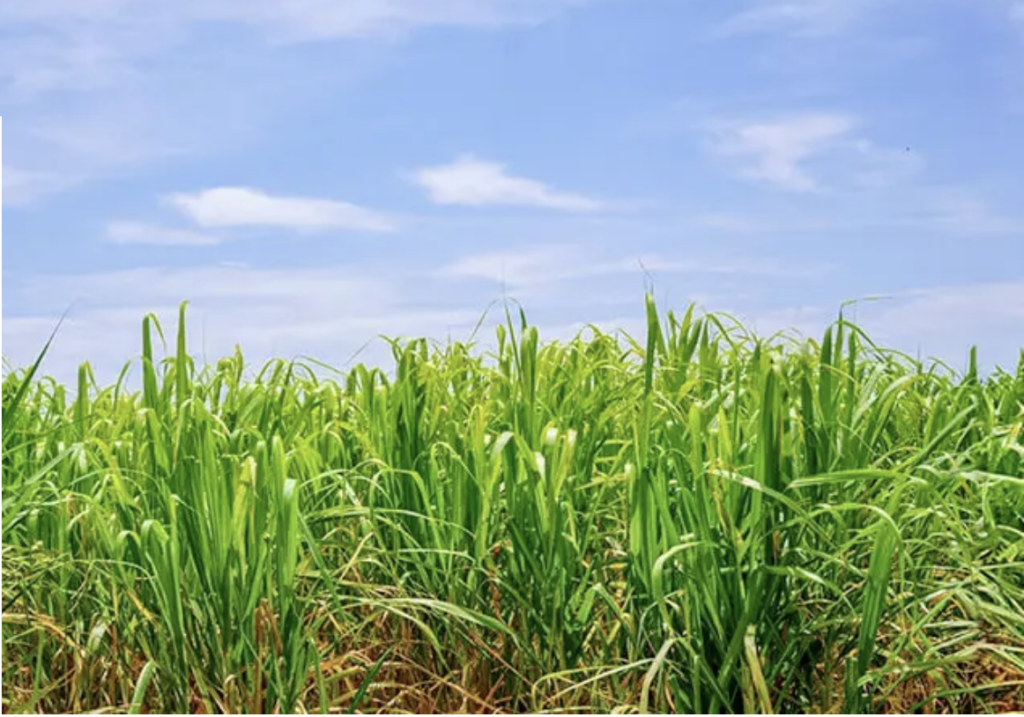
Sugarcane involves hard work such as weeding and harvesting, but because it needs relatively little fertilizer, he felt it was something they could take on as farming.
Learning from the farmers around them, they grew sugarcane and used it to make rum.
Growing sugarcane and making rum started almost at the same time.
“Maybe I just don’t like standing still.”
Shochu is a spirit that involves a lot of waiting, from storage until shipping.
He told me he also felt a fear of being left behind if he stayed the same.
Taking over a shochu distillery, growing sugarcane, and starting to make rum.
Hearing that, President Tanaka’s drive made perfect sense to me.
Choosing Agricole Rum
What RURU RUM works on is agricole rum, made from fresh sugarcane juice.
The harvested cane is pressed, and the juice is fermented and distilled.
The land where the cane grows, the variety, the harvest timing, and the condition of the juice after pressing.
These differences in raw material are important when thinking about the character of the spirit.
President Tanaka has also broadened his interest to sugarcane varieties.
If the variety changes, perhaps the character of the rum will change too.
Asakura gets properly cold in winter.
Sugarcane is basically harvested once a year.
Sugar content tends to rise as it gets colder, and the condition of the raw material changes with harvest timing. These are important elements of rum making.
In fact, when they made a batch with sugarcane that had been left for a while after harvest, fermentation progressed differently and a different character emerged.
And apparently some people preferred that flavor.
I once visited distilleries in Martinique.
There, they explained sugarcane varieties to me very carefully.
When I told him about it,
“In the end, maybe it all comes back to that. To the raw material.”
said President Tanaka.
In Asakura, too, rums with all kinds of character may be born from different sugarcane varieties and growing methods.
Searching for the Ideal Aroma: Researching Yeast
RURU RUM began distilling in 2023.
In the early days, production was small, only a few hundred bottles a year.
President Tanaka was not yet satisfied with the aroma of the finished rum.
At first they used an imported yeast for three years, but he wanted to aim for a clearer, fresher spirit.
He wanted to keep the character typical of agricole.
But he wanted to hold back the aromas that felt heavy.
So he took on yeast research.
Working with a local industrial technology center and Kyushu Sangyo University, they collected yeasts from local farm produce, fruit and more.
From these, they carried out research to select the ones suited to rum making.
In batches made with the newly selected yeast, the heavy aromas they had struggled with were held back, and the spirit has moved in a fresher direction.
Is there a yeast that brings out an even more floral aroma?
The research continues today.
What I found interesting was that they don’t decide the target aroma by feel alone.
Together with the researchers, they compared more than 20 agricole rums, organized their aroma characteristics and mapped them.
From those with floral aromas to those with almost no aroma at all.
By organizing each one’s characteristics, they think about the direction they want to go.
They also created a flavor wheel to communicate rum aromas in an easy-to-understand way.
They think not only about making rum, but also about how to convey the differences.
I really want to see that flavor wheel myself.
Making Rum with a Shochu Still
I also asked about distillation.
At present, RURU RUM uses two stills that are also used for making shochu.
The first distillation is done at atmospheric pressure, and the second under reduced pressure (vacuum distillation).
President Tanaka believes this method suits their current equipment.
But in the future, he would like a still dedicated to rum.
He has ideas about what kind of still would be best, but installing one is still ahead.
Sugarcane variety, yeast, still.
It seems RURU RUM still has plenty of things they want to try.
What the Label Holds
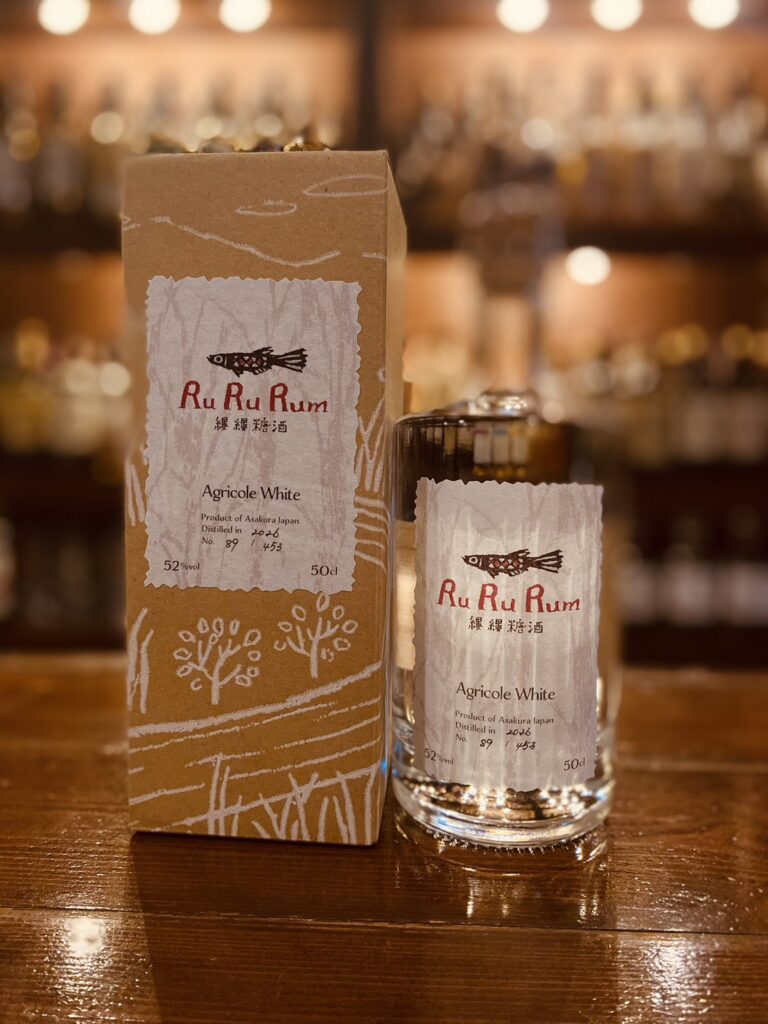
The RURU RUM label features a medaka, a Japanese rice fish.
When I asked why, I learned it’s because President Tanaka keeps medaka at the company.
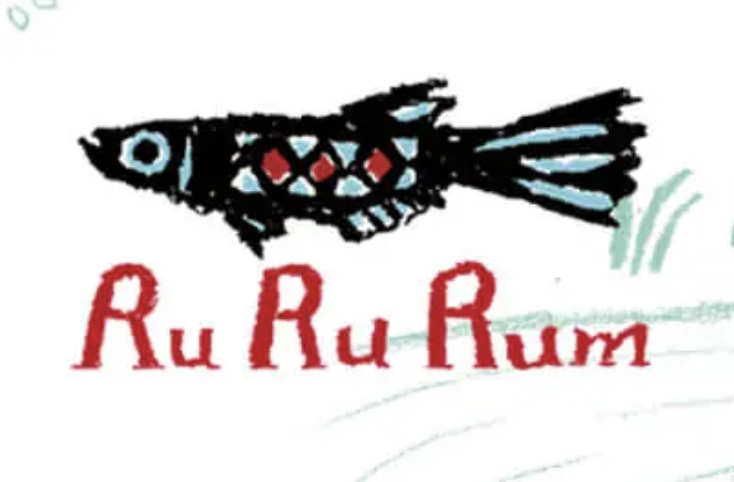
Medaka come in many colors and shapes.
It would be fun to turn medaka of different colors into characters as the series expands.
The label was born from that idea.
However, for the gold label planned for future release, they decided to use a deer instead of a medaka.
Why a deer?
When you grow sugarcane in Asakura, deer and wild boar come into the fields.
For those growing crops, they can be a nuisance.
But as long as you farm in nature, you have to think about coexisting with wild animals.
With that thought in mind, they chose the deer for the label.
President Tanaka also talked about his hunting license.
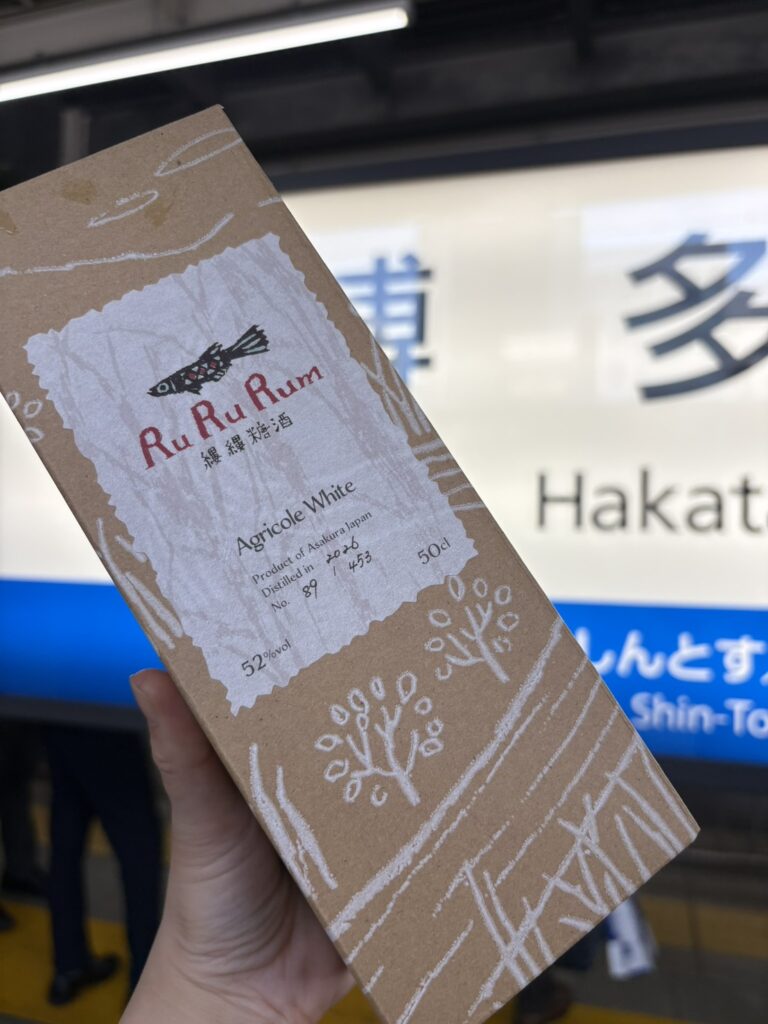
The label is designed by a woman in Kurume who does mimeograph (gariban) printing, whom they met through Instagram.
The satoyama and rivers of Asakura, and the animals that live there.
The landscape where the sugarcane is grown is expressed on the label, too.
A Rum Loved by Local People
I asked President Tanaka what kind of rum he wants to make from here on.
He wants local people to drink it more casually.
And he wants it to become a spirit local people can be proud of.
And beyond that, he hopes people far away will enjoy it, too.
That is what he shared with me.
What does it mean to be ‘Fukuoka-like’?
He is searching for that answer right now.
Even though I dropped in unannounced in the middle of the event, President Tanaka kindly took time between customers to talk with me.
Thank you very much.
Next time, I would love to visit the distillery and the sugarcane fields in Asakura.
Official Tasting Notes
Fresh green aromas from the sugarcane, with a gentle sweetness spreading across the palate.
Light hints of fresh citrus and dried herbs.
A surprisingly clean agricole rum!
Please give it a try!!
In the next episode: the story of RURU RUM GREEN, made with lemongrass grown in Asakura.
→ [Episode 2: Lemongrass in Rum?! RURU RUM GREEN and Another Maker I Met in Asakura]
For Japanese rums from across Japan, see this guide.
→ What Is Japanese Rum? A Guide to Japan’s Rum Distilleries, by a Bartender Who Visits Them
Whisky and rum taste even better when you know the hearts of the people who make them.
Every encounter is meant to be. Welcome to the world of Rum&Whisky.
[About the author]
Mika Tanimoto
CEO, Little.m Inc. / Owner-bartender
Since 2006, I have run Bar Little Happiness, a whisky and rum bar in Nagarekawa, Hiroshima. I visit distilleries in Japan and around the world and write about the people who make the spirits. Recipient of the Hiroshima City Excellent Skilled Worker Award.
“Whisky and rum taste even better when you know the hearts of the people who make them.”
[Visit the bar] 📍 Bar Little Happiness
Rolling Nagarekawa 1F, 5-14 Nagarekawa-cho, Naka-ku, Hiroshima
Mon–Sat 7:00 pm – 12:30 am / Sun 7:00 pm – 12:00 am (closed when I travel to visit distilleries)
No cover charge, no reservation needed