
What Is “Pure Malt”? Nikka’s Distillery-Exclusive Pure Malt Red & Black Explained
2026.10.05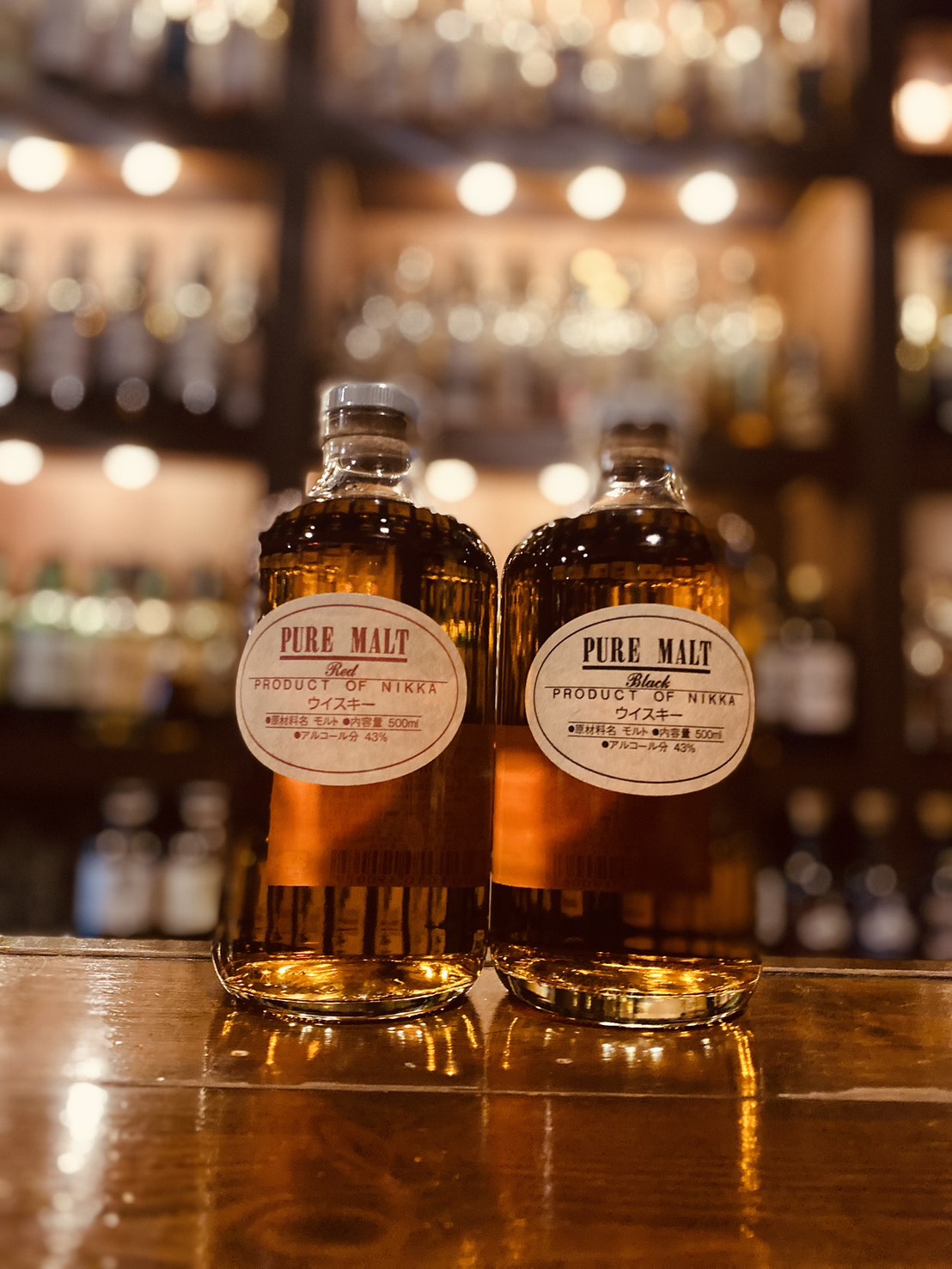
In short: what is “pure malt”? Once used in Scotch for both single malts and blended malts, the term was banned in Scotland in 2009 after Diageo’s 2003 Cardhu affair. Nikka kept it for its 1984 Pure Malt series — Black (Yoichi), Red (Miyagikyo) and the discontinued White — meaning 100% malt with no grain. Now sold only at Nikka’s distilleries, Red and Black don’t meet Japan’s 2021 Japanese whisky standard because they include some Ben Nevis spirit. By Mika Tanimoto, owner of Bar Little Happiness in Hiroshima.
How is “pure malt” different from “single malt”?
— Decoding it through Nikka’s distillery-exclusive Red & Black!
What does “pure malt” mean?
When I serve this bottle at the counter, people sometimes ask me:
“Is it different from single malt?”
“Is it different from blended malt, too?”
“And what exactly is ‘pure’ about it?”
In fact, this simple-looking word carries several stories.
The history of whisky.
Japan’s own evolution.
And Nikka Whisky’s philosophy of being “the real thing.”
This time, using “Pure Malt Red” and “Pure Malt Black” — exclusives you can only buy at the Yoichi and Miyagikyo distilleries — as a way in, I’ll guide you through the deep world of this word 🥃
—
“Pure malt” was originally a Scotch term
It may surprise you, but “Pure Malt” was originally a term used in Scotch, too.
Before the 1980s, when the term “single malt” wasn’t properly defined by law, in the world of Scotch:
– sometimes malt whisky from a single distillery was called “Pure Malt”
– sometimes a blend of malt whiskies from several distilleries was called “Pure Malt”
— both usages existed side by side.
In other words, even with the same “Pure Malt” label, the contents could be a single malt, or a blended malt (vatted malt).
2003: Diageo’s “Cardhu affair”
This ambiguity became a major problem in 2003.
Diageo, the biggest player in the whisky industry, released a product called “Cardhu Pure Malt.”
Cardhu is a single distillery in Speyside.
Naturally, consumers assumed it was “a single malt from Cardhu Distillery.”
But the contents were a blended malt: Cardhu spirit mixed with spirit from other distilleries.
The bottle design was also very similar to the existing single malt version.
Fierce criticism poured in from rival single malt distilleries and the Scotch Whisky Association (SWA).
“This misleads consumers.”
In the end, Diageo withdrew the product and returned Cardhu to single malt.
2009: “Pure Malt” banned by law in Scotch
Following this affair, the Scotch Whisky Regulations that came into force in 2009 stated:
> “Pure Malt” and similar terms must not be used at all on the labels, packaging, advertising or promotional materials of Scotch whisky.
— a clear ban.
Instead, blends of malt whiskies from several distilleries were to be called “Blended Malt.”
In other words, in Scotland, the home of whisky, the term “pure malt” can no longer be used.
—
So why is “pure malt” still used in Japan?
A name that disappeared in Scotch is still treasured in Japan —
and here, Nikka Whisky’s philosophy comes into view.
1984: marking the 50th anniversary
On 2 July 1934, “Dai Nippon Kaju Co., Ltd.” was founded in Yoichi, Hokkaido.
Its founder was Masataka Taketsuru, later called “the father of Japanese whisky.”
Exactly 50 years later, in November 1984,
Nikka released the “Pure Malt” series.
Black (mainly Yoichi malt) and Red (mainly Miyagikyo malt).
Three years later, in June 1987, White (heavily peated) joined, completing the three siblings.
“Pure 100% malt, without a single drop of grain”
At the time, the Japanese market was still in the heyday of blended whisky.
Blended whisky — malt whisky (100% malted barley) mixed with grain whisky (corn and other grains) — was what everyone drank at home and in bars.
Into that, Nikka threw this message:
> “What we make is whisky that is ‘purely’ 100% malt, without a single drop of grain.”
— that was the message.
“Pure malt” was chosen as a simple way to convey this idea of “purely 100% malt.”
An unadorned design, like a medicine bottle
In fact, the bottle design of the “Pure Malt” series is also elaborate.
It was designed by graphic designer Taku Satoh.
The same designer behind the “From the Barrel” bottle.
A short spout and a rugged, distinctive form like a medicine bottle.
A simple kraft paper label.
An appearance stripped of all decoration.
“In an era when whisky had become a tool symbolising economic wealth, deliberately removing decoration to shine a light on whisky’s true value” —
that concept runs through the design.
“The real thing, as it is.”
The Pure Malt series expresses Nikka’s philosophy in the best possible form 🥃
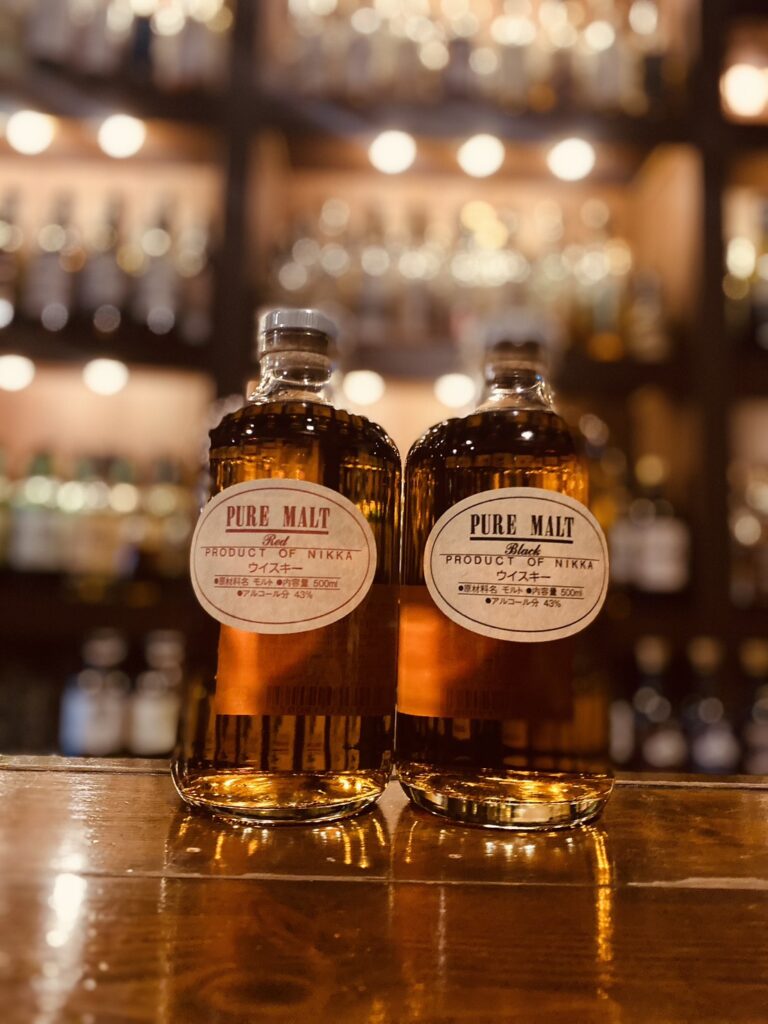
⚫ Pure Malt Black (distillery exclusive)
Its base is malt whisky from Yoichi Distillery.
A quick recap of Yoichi’s features:
Direct coal-fired distillation:
A traditional method, rare in the world, of stoking coal under pot stills that exceed about 1,000°C
Straight-head pot stills:
Many flavour compounds remain in the distillate, creating a powerful, complex taste
Sea breeze and a cool climate:
Yoichi’s Scotland-like land gives the spirit hints of peat and salt
Together, these create Yoichi’s “heavy, masculine malt.”
Official tasting notes
🥃 A heavy style based mainly on Yoichi malt
🥃 Powerful peat, solid richness and a full flavour
Nose:
– Sea, smoky, peat
– With time, hints of vanilla, honey and apple
Palate:
– Honey, vanilla, saltiness
– Peatiness, smoky depth
🔴 Pure Malt Red (distillery exclusive)
Its base is malt whisky from Miyagikyo Distillery.
Miyagikyo’s features are the opposite of Yoichi’s:
Indirect steam distillation:
Slow distillation with steam at about 130°C gives the spirit smoothness
Bulge-type pot stills:
An upward lyne arm and a rounded bulge circulate vapour and flavour compounds, creating a light, floral spirit
The nature of a misty valley:
The clear Nikkawa River, surrounded by mountains on all sides
Together, these create Miyagikyo’s “floral, gentle malt.”
Official tasting notes
🥃 A soft style based mainly on Miyagikyo malt
🥃 Light, sweet vanilla and fruity aromas, a soft, gentle taste
Nose:
– Floral, fruity
– Aromas full of fruit
Palate:
– Quince candy, honey, vanilla
– From a slightly powdery texture, gradually turning sweet
—
| The story of White, the lost youngest sibling
In fact, the Pure Malt siblings had one more member.
⚪ Pure Malt White (discontinued August 2015)
Released in June 1987, three years after Red and Black.
At first, it is said to have been blended with malt imported from Islay, Scotland (such as Bowmore).
Later, the share of imported spirit was reduced, and it shifted to mainly Yoichi’s heavily peated style.
It was known for an intense smoky flavour reminiscent of seaweed and iodine.
However —
In Japan at the time, few people liked peaty, heavy flavours.
Its sales lagged behind Red and Black, and with a shortage of spirit, it became the first in the series to be discontinued.
“In Japan, peaty flavours tended to be avoided, so it may not be re-released unless something special happens” — so they whisper in the industry.
If it had been released now, when Islay malts have become mainstream in Japan, it might have had a different fate — a slightly bittersweet bottle.
It trades at premium prices as an old bottle, but I want to remember it as a record of Nikka’s pioneering challenge 🥃
—
Nikka’s legacy: “Real malt, more approachable”
1984, the heyday of blends.
An era when expensive single malts were still out of reach for most people.
Nikka offered Japanese whisky culture a choice: “the real thing, 100% malt, at a more approachable price than single malt.”
Forty years on, that philosophy is still carried on.
A bottle only those who visit the distillery can get.
A plain kraft paper label.
Inside, mainly Yoichi and Miyagikyo malts, the pride of the world.
No flashy advertising, no limited numbering to play up scarcity.
Simply: “good whisky, at a fair price.”
Could there be a more honest bottle? 🥃
—
⚠️ A note on the definition of Japanese whisky
Finally, there’s something I want you to know.
Pure Malt Red & Black do not meet the requirements of the “Japanese Whisky labelling standards” that took effect in April 2021.
These are labelling standards set by the Japan Spirits & Liqueurs Makers Association. The main requirements are:
– Raw materials limited to malted grain, other cereal grains, and water drawn in Japan
– Mashing, fermentation and distillation must take place at a distillery in Japan
– Matured in Japan for at least three years in wooden casks of 700 litres or less
– Bottled in Japan
Pure Malt Red & Black are thought not to meet these requirements because a small amount of spirit from overseas, such as Ben Nevis in Scotland, is blended in.
But this in no way means “lower quality.”
Rather —
Ben Nevis Distillery is a historic Scotch distillery that Nikka Whisky acquired in 1989.
In Scotland, the home of whisky that Masataka Taketsuru loved as the place of his training, Nikka still owns its own distillery and keeps making real Scotch.
“Combining spirits matured in different environments makes whisky deeper and richer” — this was the philosophy Masataka Taketsuru pursued all his life.
The strength of owning spirits from around the world and blending them generously.
Nikka’s steadfast attitude of making the most of that is the “real power” that lives in this simple bottle 🥃
Even outside the frame of the definition — no, precisely because it is outside it — there is a taste worth sharing.
That is what Pure Malt Red & Black are.
—
Line up the siblings at Little Happiness
From the single word “pure malt” come:
the history of Scotch,
Japan’s own evolution,
the 50th anniversary,
Taku Satoh’s bottle design,
the contrasting sibling distilleries of Yoichi and Miyagikyo,
the story of White, the lost youngest,
and Nikka’s philosophy, unwavering even beyond the frame of a definition.
— so many stories connect in a single glass.
On the back bar of Little Happiness, we have both Pure Malt Black and Red.
Please line them up and enjoy them slowly, one glass at a time.
“Whisky and rum taste even better when you touch the hearts of the people who make them.”
Every encounter is meant to be.
Welcome to the world of Rum&Whisky.
[About the author]
Mika Tanimoto
CEO, Little.m Inc. / Owner-bartender
Since 2006, I have run Bar Little Happiness, a whisky and rum bar in Nagarekawa, Hiroshima. I visit distilleries in Japan and around the world and write about the people who make the spirits. Recipient of the Hiroshima City Excellent Skilled Worker Award.
“Whisky and rum taste even better when you know the hearts of the people who make them.”
[Visit the bar] 📍 Bar Little Happiness
Rolling Nagarekawa 1F, 5-14 Nagarekawa-cho, Naka-ku, Hiroshima
Mon–Sat 7:00 pm – 12:30 am / Sun 7:00 pm – 12:00 am (closed when I travel to visit distilleries)
No cover charge, no reservation needed