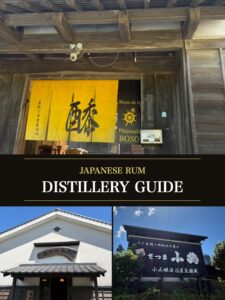

Kanosuke Distillery Report: The Secret of “Mellow” Whisky — Worm Tubs, Mellow Kozuru and a Sunset over the East China Sea (Kagoshima, Japan)
2026.10.05
In short: what does “mellow” mean at Kanosuke Distillery in Hioki, Kagoshima, Japan? Carefully clarified wort, 5–6 days of fermentation, three stills with about eight distillation patterns, rare worm tubs, seven warehouses organised as Legacy, Community and Terroir, and the story of Mellow Kozuru, Japan’s first aged shochu (1957). I found the answer at sunset over the East China Sea. By Mika Tanimoto, owner of Bar Little Happiness in Hiroshima.
Kanosuke Distillery: the secret of “mellow” whisky
What does “mellow whisky” actually mean?
Browsing Kanosuke’s website, the word “MELLOW” appears again and again.
MELLOW LAND, MELLOW WHISKY.
The catchphrase that represents Kanosuke.
Calm. Soft. Smooth.
I thought that might be what it meant — but when I actually drink it, I feel there is more to it.
So what is the “mellow” Kanosuke talks about?
This time, I went looking for the secret as I walked through Kanosuke Distillery.
Does “mellow” already begin with making the wort?
“If you want to paint a beautiful picture, it’s better to have lots of colours of paint.”
That is what Ono-san, who showed me around the distillery that day, told me.
From the start, Kanosuke makes many different kinds of spirit.
They don’t narrow it down to one flavour.
To gather all those colours of paint, it starts with making the wort, the foundation.

Mashing is done slowly and carefully.
This process, I was told, leads to a smooth flavour with delicate aromas.
The very first wort, not yet anything close to whisky.
Here, the finished wort is clarified thoroughly.
And they make sure of it with a double check — by machine and by eye.
Is there any cloudiness? Is it perfectly clear?
They check one by one.

It isn’t even whisky yet,
but already, the preparation for “smoothness” has begun.
And here’s a little side story.
Cleaning after production is really hard work.
A person climbs inside the tank and scrubs it with a brush.
In summer, the tap water itself can be over 30°C, so working in there leaves you drenched in sweat.
The cleaning happens every day and can take 30 minutes to an hour.
“I get this sweaty and I still don’t lose weight,” Ono-san laughed playfully.
After all this work, when the new make comes out delicious, Ono-san said, the hardship turns into joy.
And then, the wort goes to fermentation
The clean, clarified wort goes into the washbacks.
At Kanosuke, it ferments for about 5 to 6 days in stainless steel tanks.
For whisky, that is a relatively long fermentation, I was told.

When I saw it, it was exactly day three.
Inside the tank, it was already foaming.
“The foam gets stronger and stronger, until it’s like it’s boiling up.”
This long fermentation creates a wash with a creamy, rich flavour.
And here, something else caught my attention.
The fermentation room is really spacious.

“Why is it so big?”
I asked, and the answer was:
“The size here doesn’t really mean much.”
Oh, really? (lol)
But once a year, this place also hosts a Shinto ritual connected to making alcohol.
Then it clicked for me.
Before coming here that day, I had stopped by the Hachiman Shrine.
The origin of the Komasa family’s brewing is making sacred sake offered to the Hachiman Shrine in Hioki.


Three stills that make many kinds of spirit
Once fermentation is finished, the wash finally goes to distillation.
Unusually for a craft whisky distillery, Kanosuke uses three stills.

The one on the left is the wash still.
The two on the right are spirit stills.
Look closely and you’ll see these two are different shapes.
The middle one has a downward lyne arm and makes a relatively rich, heavy spirit.
The one on the right, meanwhile, has an upward lyne arm and a lantern shape.
It is used to make a light, clean spirit.
“So basically, you’re set up to make lots of variations right from the start?”
I asked, and that was exactly it.
Depending on how the three stills are combined, the distillation pattern changes.
Besides standard double distillation, some combinations involve triple distillation.
In total, there are about eight patterns.
Amazing.

At the end of each still is the condenser.
Kanosuke uses worm tubs, which have become rare today.
A spiral copper pipe sits in a tank of cooling water, and the vapour passes through it.
It is a traditional method, and its feature is relatively little contact between the spirit and copper.
(Today, shell-and-tube condensers are the mainstream, and few distilleries use worm tubs.)

This plays a big role in keeping the power that stretches to the back of your tongue, and the backbone of the spirit, I was told.
Wait?! Maybe “mellow” isn’t only about being soft.
Kanosuke’s “MELLOW,” growing in the cask
So far, we have looked at the story up to becoming whisky.
So what happens to the spirit after it comes out of the still?
To understand maturation at Kanosuke, you have to start with the story of “Mellow Kozuru.”

In 1957, Kanosuke Komasa, the second generation of Komasa Brewery, released “Mellow Kozuru,” Japan’s first aged shochu.
Noticing that the world’s spirits gain deep flavour through long maturation, he aged rice shochu in wooden casks for six years.

The name “Mellow” was given by Kanosuke-san at that time,
“I want people to enjoy it with a relaxed heart.”
That was the wish behind the name, I was told.
And Kanosuke-san had one more dream.
To build a dedicated distillery in “the land with the most beautiful sunsets in Japan,” and spread Kagoshima’s spirits culture to the world.
With that wish, he acquired land by Fukiage Beach.
A plan was underway to build “a distillery dedicated to Mellow Kozuru.”

However, the shochu boom ended, and with Kanosuke-san’s death, the plan fell through.
But the warehouse for Mellow Kozuru had already been built.
That is the “Legacy warehouse” that still stands today.
And 60 years later, in 2017.
The fourth generation, Yoshitsugu Komasa, took up his grandfather’s ambition and began making whisky.
The challenge of “raising spirits in casks” that began with Mellow Kozuru has changed shape over time, and leads to the Kanosuke of today.
Kanosuke now has seven warehouses.
They are organised under three ideas — “Legacy,” “Community” and “Terroir” — each raising spirit in a different environment.

(Borrowed from their website)
Legacy is what has been handed down.
Community is the connection with the region.
And Terroir is this land itself.
The type of cask.
The size of the cask.
The environment of the warehouse.
Even spirit made at the same distillery slowly changes its expression because of these differences.
Roundness, complexity and depth that weren’t there when it was freshly distilled.
They are born, little by little, inside the cask.

The secret of mellow
Kanosuke doesn’t define anywhere what “mellow” means.
The heading of their visitor page is “The Secrets of Mellow Whisky.”
Secrets.
I think it means: come, see and feel it for yourself.
The making, the history, this land — all of it.
▼ The “MELLOW BAR” inside the distillery
From here on, I think the video says it faster than my words. Please watch it to the end.

In front of me, the East China Sea.
The sun sinks slowly.
Not hurrying, not stopping.
The sky and the sea change colour little by little.
The Kanosuke in my glass was sweet, with real body.
Even after swallowing, it stays at the back of my mouth.

Oh, I thought.
It’s the same.
It moves just like this sunset.
It sinks slowly, and even after it has set, the red lingers for a while.
Kanosuke’s finish was the same.
It doesn’t just vanish.
I found out later that Kanosuke describes its own flavour like this:
“A flavour with a long finish, like the sun slowly setting into the East China Sea.”
The makers were looking at the same thing.

I thought back over the process I had walked through.
Wort clarified by eye.
The creamy feel of fermentation over 5 to 6 days.
The sturdy character left by the worm tubs.
Time in the cask, slowly rounding off the edges.
None of it was rushed.
All of it, unhurried.
And the flavour made that way fades at the same speed as this land’s sunset.

I think that’s probably what “mellow” means.
The Kanosuke Local Barley I drank that day, watching the sun set into the East China Sea.
Unhurried, sweet, a little like apples.
A very relaxed, unhurried time.
I’m sure this is Kanosuke’s MELLOW, for me.
Whisky and rum taste even better when you touch the hearts of the people who make them.
Every encounter is meant to be. Welcome to the world of Rum&Whisky.
[A note from Tanimoto] This article about Kanosuke Distillery is based on my own visit, but it also includes some of my personal thoughts and interpretations. Please enjoy it as the musings of one whisky lover.
Finally, my heartfelt thanks to Ishihara-san of brand advocacy and Ono-san, production supervisor at Kanosuke Distillery, for showing me around so kindly.
For me, the time we spent together is part of “mellow,” too.
Thank you for such wonderful memories!!

[About the author]
Mika Tanimoto
CEO, Little.m Inc. / Owner-bartender
Since 2006, I have run Bar Little Happiness, a whisky and rum bar in Nagarekawa, Hiroshima. I visit distilleries in Japan and around the world and write about the people who make the spirits. Recipient of the Hiroshima City Excellent Skilled Worker Award.
“Whisky and rum taste even better when you know the hearts of the people who make them.”
[Visit the bar] 📍 Bar Little Happiness
Rolling Nagarekawa 1F, 5-14 Nagarekawa-cho, Naka-ku, Hiroshima
Mon–Sat 7:00 pm – 12:30 am / Sun 7:00 pm – 12:00 am (closed when I travel to visit distilleries)
No cover charge, no reservation needed